
School and Government E-Waste: A Practical Guide to Compliant IT Asset Disposal
Every August, school districts finish summer IT refreshes and government agencies close out fiscal years. New devices come in, then old ones get moved to a storage room, a closet, or a back office — and stay there.
The equipment is out of circulation, but the problem it creates isn't.
This guide covers what compliant device disposal actually requires for schools and government agencies, what regulations apply, and how to implement an easy process that ensures compliance.
Proper Disposal of Old Computers: Why It Matters

Removing a device from service doesn't remove your organization's responsibility for what's on it. A laptop used by a staff member, a tablet issued to a student, a workstation connected to the agency network — the data liability follows the device until certified destruction ends it. For schools and government agencies, that liability is a regulatory requirement.
But compliance is only part of the picture.
Electronics that end up in landfills leach hazardous elements into soil and groundwater. Responsible electronics recycling keeps those materials out of the environment and recovers valuable components that would otherwise be lost — a meaningful consideration for public institutions with sustainability mandates or community accountability.
Engaging a qualified ITAD provider also helps your organization optimize in multiple ways, from assessing retired assets for recoverable value to clearing up storage and freeing up your IT team’s time for more important work.
Done right, e-waste disposal solves four problems at once: data security, environmental responsibility, asset recovery, and reclaimed space. Most organizations are only thinking about one of them.
What the Regulations Actually Require
Schools: FERPA

The Family Educational Rights and Privacy Act prohibits the unauthorized disclosure of personally identifiable information from student education records — names, addresses, student ID numbers, and other identifying data.
That obligation doesn't end when a device is retired. Ensuring that any student data is gone through certified data destruction is the best way to remain compliant.
Government Agencies: FISMA and State Requirements
Federal agencies and the contractors that work with them operate under the Federal Information Security Modernization Act, which requires documented, agency-wide information security programs built around NIST standards.

For device disposal specifically, NIST SP 800-88 — the federal media sanitization guideline — establishes the benchmark for how data is cleared, purged, or destroyed before equipment leaves organizational control. While FISMA requirements apply directly to federal agencies, state and local government agencies that handle federal data or participate in federally funded programs are often subject to equivalent standards through their program agreements.
If your agency handles federal information, it's worth confirming which sanitization standards apply before devices are decommissioned.
Healthcare-Adjacent Government and School Health Programs
Schools and government agencies that handle any protected health information — school nurses, Medicaid-funded programs, public health departments — also carry HIPAA obligations for devices that stored that data.
Choosing the Right Provider
Not all IT asset disposal providers are equal, and for schools and government agencies the difference matters. A qualified provider brings certifications, documentation, and downstream accountability that protect your organization long after the equipment is gone.
What to verify before engaging a provider:
NYS DEC Registration confirms the facility is operating legally under the Electronic Equipment Recycling and Reuse Act. An unregistered facility isn't just an environmental risk, but a sign that the operation isn't subject to the oversight responsible handling requires.
R2-Certified Downstream Partners means the recycler's processing chain meets responsible recycling standards.
Certificate of Destruction is the document that closes the compliance loop. It should specify which devices were processed, to what standard, and by whom. This is essential for your audit trail.
Pickup Logistics matter practically. Bruin offers free pickup for qualifying volumes, which means no transportation costs, no staff time sorting and palletizing equipment, and no liability gap between your facility and the recycler's.
Asset recovery capabilities can also help your organization assess equipment qualified for redeployment, which can help offset processing costs.
Worth Considering: Recurring vs. One-Time Pickup
Schools running annual device refreshes and government agencies with regular hardware cycles benefit from a structured pickup schedule rather than ad hoc requests.

A recurring pickup arrangement means equipment doesn't accumulate between cycles, compliance documentation stays current without scrambling at year-end, and IT staff aren't pulled away from other work to manage logistics. For organizations managing consistent volumes, building end-of-life asset management into the regular calendar is significantly less disruptive than treating it as an afterthought when storage space runs out.
For organizations that haven't done this before, a single pickup is enough to establish a baseline process, get documentation in order, and understand what a recurring program would look like. Benefits include:
Predictable timelines that make budget planning and device refresh cycles easier to manage
Reduced staff burden — your IT team schedules one recurring pickup instead of managing logistics every time devices pile up
Current compliance documentation that doesn’t require a last-minute scramble before an audit
How Bruin Works with Schools and Government Agencies
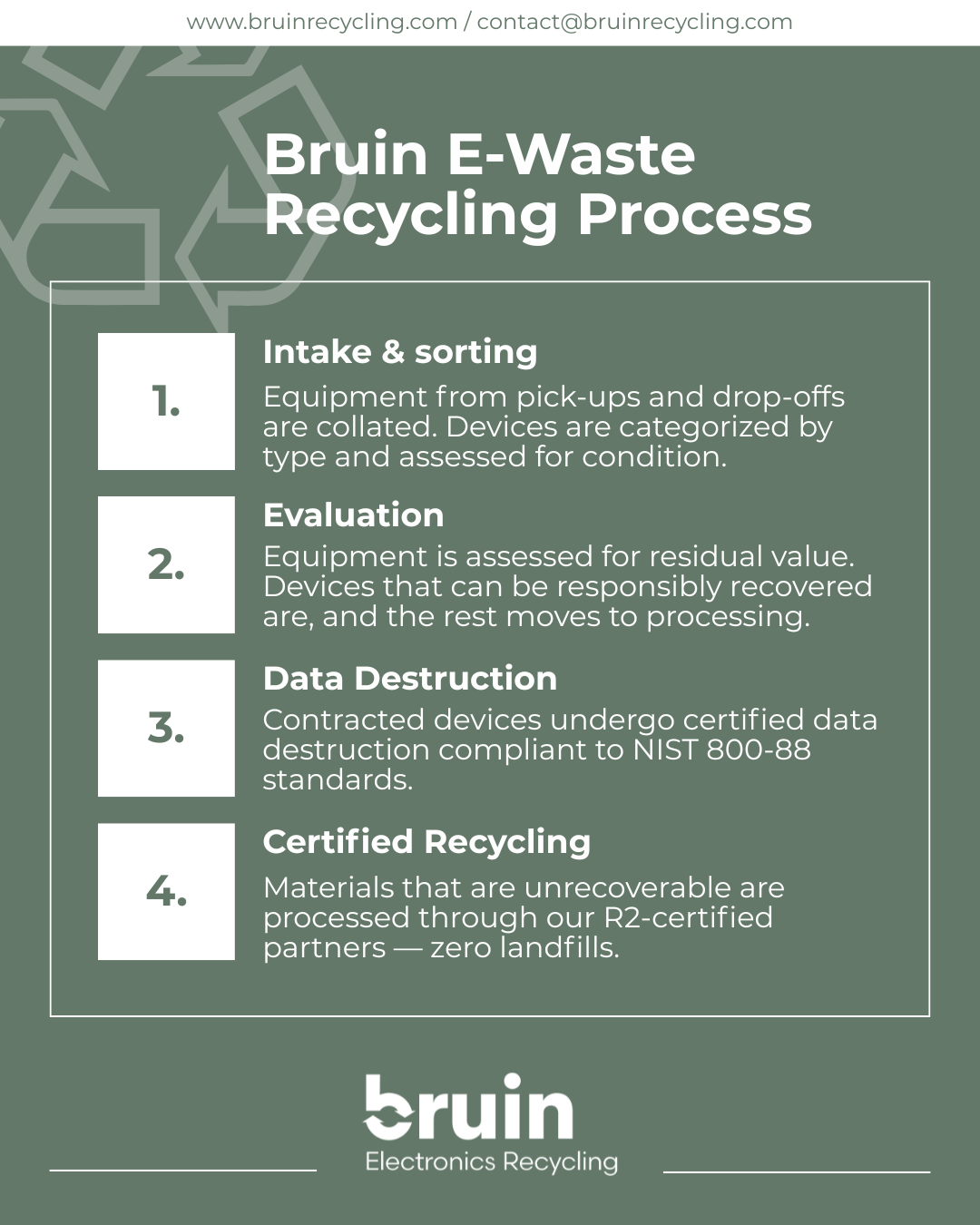
Bruin has spent 20+ years working with school districts, government agencies, and public institutions across the U.S. and Canada. We're NYS DEC-registered and work exclusively with R2-certified downstream partners.
We offer free or low-cost pickup for qualifying volumes, certified data destruction to DoD and NIST standards, asset recovery, and responsible recycling. No sorting required on your end.
Whether you're a small district retiring 15 laptops after a summer refresh or a multi-site agency decommissioning an entire floor of workstations, the process is the same: secure, convenient, and documented.
Contact us to set up a free assessment and build a pickup schedule built around your timeline.